
From Workload to Workflow: The Quiet Shift Changing How Forwarders Operate
From Workload to Workflow: The Quiet Shift Changing How Forwarders Operate
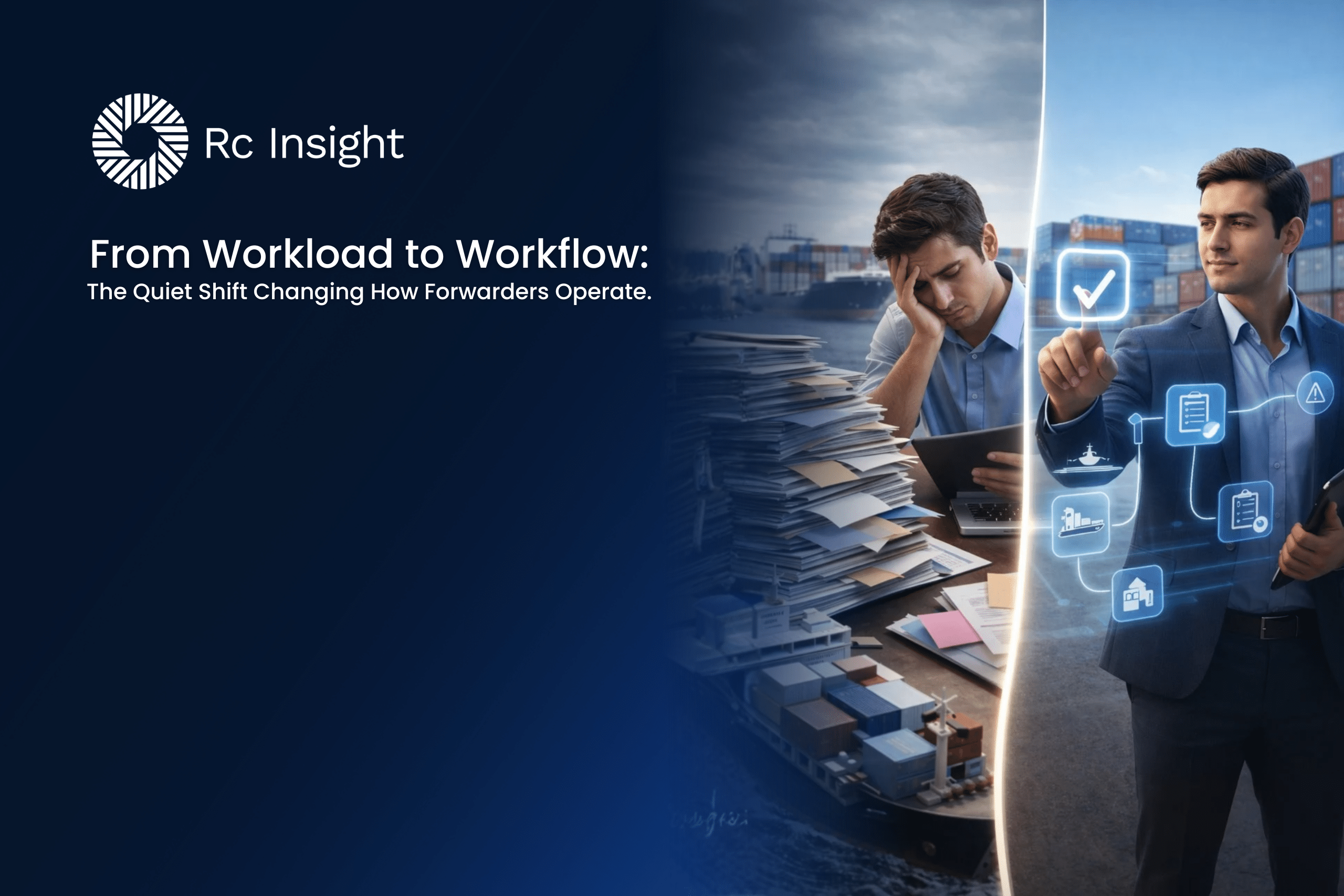
In 2026, the freight forwarding industry is not being reshaped by companies that work longer hours or push their teams harder. It’s being reshaped by those that have fundamentally rethought how work gets done.
The fastest-growing forwarders today are not adding more people to manage complexity. They are removing complexity altogether by aligning operations, technology, and decision-making into intelligent workflows.
This is a quiet shift. But it is transforming how global logistics operates.
The Old Model: More Shipments Meant More WorkFor decades, growth in freight forwarding meant scaling workload.
More shipments required:
- More emails
- More spreadsheets
- More manual data entry
- More coordination across disconnected systems
- More firefighting when something inevitably went wrong
Operations teams became human middleware, moving information between carriers, customers, customs, and internal systems. Efficiency depended on individual experience rather than process design. Visibility was reactive. Decisions were delayed. Errors were absorbed as “part of the job.”
That model no longer holds.
Today’s supply chains demand speed, predictability, and transparency at a level manual workflows simply cannot deliver.
The New Reality: Workflow-Driven ForwardingForwarders that are scaling successfully are redesigning operations around workflows, not tasks.
Instead of asking:
“Who will handle this shipment?”
They are asking:
“How should this move through the system automatically?”
This shift is being powered by three major changes.
1. Automation Is Replacing RepetitionModern forwarders are aggressively eliminating manual touchpoints using automation and robotic process workflows.
Routine activities such as:
- Rate comparisons
- Booking confirmations
- Documentation checks
- Status updates
- Invoice matching
are now executed automatically through integrated platforms.
Operations teams are no longer spending hours copying data between systems. They are managing exceptions, not transactions.
One global forwarder reduced manual processing in finance and shipment administration by deploying automation that now handles the workload equivalent of hundreds of employees. The result was not downsizing. It was redeployment of talent toward customer service, planning, and growth initiatives.
Automation did not remove people from the process. It removed friction.
2. Visibility Has Moved from Tracking to IntelligenceTraditional shipment tracking answered one question: “Where is it now?”
Workflow-driven forwarding answers a different question: “What will happen next, and what should we do about it?”
Forwarders are implementing real-time visibility platforms, smart sensors, and predictive analytics that provide:
- Accurate ETAs at the item level
- Early warnings for disruptions
- Condition monitoring for sensitive cargo
- Automated exception management
- Predictive capacity planning
This allows teams to act before problems escalate rather than reacting after delays occur.
In industries such as pharmaceuticals, high-tech manufacturing, and retail replenishment, this level of insight is no longer a competitive advantage. It is an operational requirement.
3. Digital Documentation Is Unlocking Speed at ScalePaper-heavy processes have long been one of forwarding’s biggest bottlenecks.
Forwarders are now digitizing bills of lading, customs filings, invoices, and compliance documentation into seamless digital flows. Documents are generated, validated, and shared across stakeholders instantly, eliminating rekeying errors and approval delays.
This has dramatically shortened processing cycles while improving regulatory accuracy.
More importantly, it allows workflows to move continuously instead of stopping at every administrative checkpoint.
From Firefighting to Flow ManagementThe biggest change is cultural, not technological.
Forwarders are moving away from reactive operations toward orchestrated movement of information and cargo.
Instead of:
- Chasing updates
- Fixing preventable errors
- Managing disconnected handoffs
Teams are now:
- Monitoring automated workflows
- Intervening only when needed
- Using data to optimize future movements
- Designing processes that scale without additional labor
The role of the forwarder is evolving from transaction handler to logistics conductor.
Why This Shift Matters NowGlobal supply chains are becoming more volatile, not less.
Geopolitical pressures, sustainability requirements, customer expectations for transparency, and the continued rise of e-commerce are all increasing operational complexity. The answer is not adding more manual effort. That only compounds inefficiency.
The companies growing in 2026 are not working harder. They are aligning their operations more intelligently.
They understand that scale comes from workflow maturity, not workforce expansion.
The Forwarder of the FutureThe next generation of freight forwarders will not be defined by how many shipments they handle, but by how seamlessly those shipments move through their ecosystem.
Success will depend on:
- Integrated digital platforms
- Automation-first process design
- Real-time decision intelligence
- Exception-based human intervention
- Continuous operational alignment
This transformation is not loud. It does not arrive as a single disruptive innovation.
It happens quietly. Process by process. Workflow by workflow.
But its impact is redefining what operational excellence looks like in global logistics.
And the forwarders embracing it today are building the foundation for the next decade of growth.